
It was the second straight week of gains for the benchmarks.
Rise in crude oil price and rally in global equities aided the sentiment
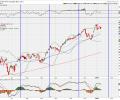
It is too early to say if we have seen the "final" bottom to these stocks in August 2013 or if another attempt to test them will be made before or just after elections, says Sonali Ranade.
Metals bucked the trend and shone across the board.

The S&P BSE Sensex surged 364 points to end at 24,607 and the Nifty50 soared 107 points to close at 7,476.

Benchmark share indices trimmed intra-day gains after global crude oil prices resumed their downward trajectory after sharp gains on Friday.
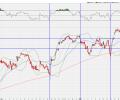
In India, however, the Nifty continues to climb a wall of worry as general elections loom, fiscal deficit surges and the current account deficit is barely under control following subdued gold and crude prices, says Sonali Ranade.
Gains were led by index heavyweights Reliance Industries and Infosys.

The Sensex has slid 18.5 per cent from its January 2015 peak.

Sentiment was largely positive after April IIP grew at 4.9 per cent, spurred by higher growth in manufacturing and mining sectors.

The S&P BSE Sensex closed 318 points at 24,455 and the Nifty50 shed 99 points to end at 7,438.

The BSE Midcap and Smallcap indices underperformed the largecaps and ended over 1% lower.

World Bank lowered its global economic growth outlook for 2016 to 2.9% from 3.3% earlier.

On the sectoral front, rate-sensitive sectors such as Bankex and Auto gained by 1% and 0.7% respectively while BSE Consumer Durables gained 1.4%.

Coal India topped the losers' list in the Sensex pack on Tuesday, falling 2.36 per cent, followed by Bharti Airtel at 2.16 per cent.

The top gainers on the Sensex are Gail(India), HDFC, Infosys.

Despite a strong start to trade today, key benchmark indices retreated sharply from their higher levels following bouts of profit-taking amid fresh weakness in the rupee against the dollar.

A declining rupee, elevated crude oil prices and sustained foreign fund outflows added to the gloom

The broader markets ended mixed with mid-caps gaining 0.1 per cent and small-caps falling 0.1 per cent on the BSE.

The broader markets ended negatively with mid-caps and small-caps shedding 0.5 per cent on the BSE.

The BSE Sensex moved up 103 points to 35,319.35, while the wider NSE Nifty finished at 10,741.70, up 23.90 points.

The broader markets ended firm with mid-caps and small-caps gaining nearly 0.5 per cent on the BSE.

The broader markets were firm with mid-caps and small-caps gaining 1-1.4 per cent on the BSE.

Sensex,Nifty to remain under pressure through the week.

The 30-share Sensex ended in the red.

Other than ITC, other laggards include PowerGrid, Infosys, M&M, NTPC, SBI, HDFC, Kotak Bank, HDFC Bank, TCS, Hero MotoCorp, Coal India, ONGC, RIL, Asian Paint, IndusInd Bank, ICICI Bank, Maruti Suzuki, Bajaj Auto, Tata Motors, Bharti Airtel and Axis Bank.

The 30 share Sensex ended up 183 points at 27,470 and the 50-share Nifty gained 44 points to close at 8,295.

The 50-stock NSE barometer Nifty finished 22.50 points, or 0.21 per cent, down at 10,526.20

The BSE Midcap and the BSE Smallcap indices pared all intraday gains to end 0.3% and 0.5% lower

The broader NSE Nifty gained 22 points to 10,480.60

The S&P BSE Midcap and S&P BSE Smallcap indices hit a new lifetime high

Investors will maintain a cautious stance.
.jpg)
The broader markets traded positively with mid-caps and small-caps rising 0.5 per cent each on the BSE.

The broader NSE Nifty too fell below the 10,100 level by dropping 100.10 points to end at 10,094.25

Sensex remained volatile through the day.

Indian indices fell more than those of most other emerging markets.

The BSE Sensex zoomed 318 points to end at 33,351.57, while the broader Nifty spurted 88 points to 10,242.65.

Tata Motors was the worst performer on the Sensex, plummeting 10.32 per cent to Rs 436.55 after the company reported a steep 96.22 per cent decline in consolidated net profit for the December quarter.

The rupee fell to a two-year low of 64.84 against the US dollar.

Analysts agree China, Greece and US Fed developments need careful monitoring but India should gain, over time, from relative rise of the dollar and fall in commodity prices.
